08/31/2006
Budo is not a show… "Its image is not the reflection of itself"
The result is far from being glorious since it participates in a vast enterprise of intoxication or even worse in a vast breach of trust, whether knowingly or not, on people that passively attend these illusionist acts.
The term "demonstration", used most often for designating the person that is performing the show, is charged with meaning when you think about just what verities they are trying to demonstrate.
Am I the strongest?... The fastest?... The most what?
When you attend a combat sport event, things are clear. Points are earned, a winner is designated, and a prize is awarded. Nobody tries to explain to us that so‑called philosophical content is hiding behind all this action.
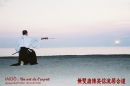
But everything is different in our case, because if I were to let you believe that the image that you see when I practice Iaido is Budo, I would be lying.
Some people thirst for spirituality, others are looking for recognition from others, and the venalities of yet others come together in these bazaars where these technicians perform who have taken only the image from the art since they haven't learned the rest. The mirror can reflect the illusion of a third dimension but in reality the image is flat and devoid of content.
Budo is a "state of being" in which all of the senses participate in fulfilling a requirement that we want to be as perfect as possible. And when I speak of senses and requirement, these are those of the person involved in this search.
Technical expression, the daily focus of our attention, is not Budo.
Correcting the image is only one of the many tools that make it possible for who is practicing to polish the physical expression of an approach that is much more complex.
14:10 Posted in THE BUDO, THE IAIDO | Permalink | Comments (0) | Email this
06/12/2006
“Kokoro i ki”….. Construction, by example.
In a previous note, I announced that I wanted to talk about the notion of “Kokoro”.
Many people have asked me to explain the meaning of the Japanese conception of Kokoro to them. People have even sometimes tried to get me to translate this concept into languages where it doesn’t even exist as such. If a literal translation existed, it would be reassuring for many people, particularly for those who believe they can progress without a Shisho.
But the search for Kokoro is worth devoting time and energy. Following the example of the knights on their quest for the Holy Grail, I strongly believe that the ‘quest’ is itself an element of Kokoro, because if it’s difficult to find the meaning of Kokoro, it’s just as difficult to put meaning into your Kokoro.
Throughout the many years we spent together, my Shishô, IKEDA Shigeo Sensei, tried to help me to understand the contents of the word by shedding new light on this concept whenever he was able to do so. Without me even being aware, he both filled me with and removed from me some of the elements that would one day enable me to follow the path towards the quest for Kokoro, by feeding me with experience and future encounters.
I still don’t know how to explain what Kokoro is in simple terms, but I immediately know how to identify the elements that are part of it or the people who convey these elements.Kokoro is the expression of a philosopher of action and definitely not an attitude of universal significance that would delight in looking for words to explain other words, and so on.Kokoro is the outer casing for the daily implementation of bushido values that I have made my own.
Makoto Honesty
Meiyo Honour
Chugi Loyalty
Yu Courage
Jin Kindness and Compassion
Gi Honesty in Behaviour
Rei Respect and Courtesy
Tchi Intelligence and Intuition
Shin Belief in human nature
The years go by and there isn’t a day when I don’t think of ways to fulfil my Kokoro through new feelings of well-being thanks to others, thanks to me and thanks to life. Kokoro only exists over time.
It is filled with what’s given to you and with what you give to others.
By making it an essential element in making decisions that dot our lives, we give meaning to the values we believe in. It would be a mistake to concentrate your energy on only wanting to fill your Kokoro with a few strong emotions that punctuate our existence. The elements that make up Kokoro can’t be ranked into importance because they all contribute to our personal enrichment, even the little things in everyday life.
And how wonderful it is if, in addition to these moments of well-being, we feel swept along from time to time by a particular behaviour whose exemplary nature and level of emotion makes us touch the very heart of Kokoro. These moments are true lessons for living… How we would so like to perpetually initiate theses moments.This is a logical consequence, because the work performed each day will bear fruit, and one day, when everything appears to be the same as it was before, people around us will in turn be deeply moved by a simple gesture that we do naturally for them, without any need to give them any sort of social justification.
Maybe they won’t necessarily identify this as being Kokoro. But what does it matter what we call it?
So that I in turn may convey what makes me progress in my quest for Kokoro, I would like to give three examples that are naturally associated with IKEDA Shigeo, my Shisho. They happened after his death and represent Kokoro i ki for me.
1. My thanks to my Kohai
Since our Shisho died almost five years ago, the ties that I maintained with my Kohai have grown stronger and our relation, a combination of kinship and mutual respect, fill me with joy and pride.
Therefore, I decided to go to Japan for three days last November, not to train, but to be by his side for one of the most important events in his life, to show him how important our relationship was to me.When we left each other on the last evening, I felt that he had understood why I had come to Tokyo. We said good-bye affectionately.
But the following morning when I came down to the hotel’s reception at 6.30am, he was there, even though I hadn’t told him what time I was leaving and that he lives 45 minutes away. He told me that he thought I wouldn’t have time for breakfast, and so he had brought me a bento (Japanese bowl) and some tea.
1. My thanks to Mrs IKEDA and the whole of her family
In January, as indeed for all my travels, I contacted Mrs IKEDA, my departed Shishô, IKEDA Shigeo’s wife, for the sheer pleasure of meeting the woman who has done so much for me.
She made the Shisho–Deshi relationship possible between me and her husband. And to this day, her perception of me motivates me in my quest, so that I may be a credit to her and to the memory of her husband.
And when I visited her in January, she was waiting for me to give me IKEDA Shigeo Sensei’s “bun kotsu” - part of his bones.
How that moment made my head spin… What a message... What responsibility…
1. My thanks to my Shisho’s close friends.For many years I lived in the “kindly shadow of my Shisho” being very careful to tread in his steps. Thanks to that, I learnt a lot and spent many wonderful years that seemed never to end.
His qualities as an exceptional and unselfish man did not leave people indifferent and many men and women of quality saw him as a devoted and sincere friend.
I was often witness to that, and even if I attempted to stay in the background, in accordance with my status as Deshi, I naturally participated in many events in IKEDA Sensei’s company and with his friends.
When he died on the 24th July 2001, we all cried.
Just as the man had been exceptional, so were his friends… Some time later, Shinobukai was born. An association where his friends regularly get together to talk about and honour his memory.
On the 16th April 2006, Shinobukai moved to Kyoto, the town where IKEDA Shigeo was born. In the morning, everyone gathered round his grave, without any particular reason other than to pay him their respects…
15:30 Posted in THE BUDO, THE SHOSHINKAN Dôjô's SPIRIT | Permalink | Comments (0) | Email this
01/30/2006
My quest for infinite progression…
The idea of classifying artists, even those performing a martial art, into higher or lower levels does not comply with my approach to art, where the main issue is about searching for truth behind appearances, and where each individual «artist» contributes something of himself to his art form.
Who would ever think of saying that Picasso was greater than Michelangelo, that Mozart was greater than Chopin, or that Baudelaire was greater than Apollinaire? Or to classify them into different levels?
Who would dare to express an opinion on the levels of MIYAMOTO Musashi, SASAKI Kojiro or SAKAMOTO Ryoma?
I elaborated at length in another note about techniques being just a support, a means to build ones own person. Attributing grades to a technique means skirting round the essential issue, making those that perform an art believe that their efforts are reduced down to mere elements that serve to assess them.
This attitude is perfectly conceivable in sports where physical performance is assessed, but not at all so in Budo.
What is reprehensible is the skilfully maintained ambiguity in certain groups that leave us to believe that the attribution of technical grades automatically comes with simultaneous recognition of a «spiritual» level. Of course this is totally untrue, but for the novice, it seems perfectly obvious.
If progress in Budo is made at first by striving for technical excellence, one has to admit that it is necessary to achieve this as quickly as possible, in order to be able to best use this support that desserts us very quickly over the years. However, if transmission has been carried out correctly, one day you will notice that you have simply changed the support, and that your progress in improving the «Kokoro» will blossom into infinity…
In this context, each individual’s level can only be subjective, in the same way that one is free to think that such or such an artist is the best in his field.
Man’s desire for power, however small, makes them want to be given grades by means of an objective ranking system to compare oneself against another, and therefore to determine, without ambiguity or possible questioning, the conditions of their life within the group to which they belong.
In this context, reducing the practice of a sport down to just techniques is reassuring, since this attitude avoids dealing with genuine transmission-related problems. Nobody should be able to come between the Shisho and the Deshi, and in any case, not structures that would superimpose an artificial hierarchical relation on one that should exist between the Shisho and the Deshi, that is to say, a relationship based on respect, mutual trust and a freely consented acceptance built on the conviction of reciprocal enhancement.
Unfortunately, many people have thought that they were progressing along the Budo path because they could see themselves progress technically, which is considered the final aim. They have been mislead by being attributed technical grades that are assumed to include other elements that have never actually existed, and find that over the years this very technique has deserted them, even though they still have their diplomas to show that they at one time successfully reached a certain level that has been lost to them for years.
Putting aside the useless and incoherent nature of this type of grading within the context of learning Budo, it should be stressed that classifying into closed ranks restricts progress by leading us to believe that the main objective is to reach a higher level.
My quest is that of my Shisho, IKEDA Shigeo Sensei, a quest that enables me to believe that everything is accessible, even the impossible.
Each individual’s ambition should be to reach and surpass the level of our senior’s and our Shisho, because this is the only way to thank them for what they have given. I endeavour to do this and help my Deshi to do the same. The Shisho is a guide and therefore he has a duty to be the guarantor for genuine progression.
10:00 Posted in THE BUDO | Permalink | Comments (0) | Email this
12/21/2005
Being a « Shishô» means being a good «Deshi » all through life
Japan has always distinguished itself from other countries in many different areas, but this specific characteristic is fully expressed in all arts, whether they be of Japanese or Western origin.
What makes each «Japanese style» practiced art different, is firstly this particular form of transmission from the Shishô to the Deshi based on very old educational principles. The originality encountered in this human relationship that combines respect and loyalty, can only lead to a form of practice that largely exceeds the purely technical context of the discipline that is being taught, this discipline merely being a support for demands that should be integrated into each individual’s life.
Using art as a tool, a means to progress.
Even if changes in the rules of life in society have sometimes enabled considerable progress in terms of improving conditions of daily living, the consequence of these changes has been a deterioration of spiritual values that are the genuine cultural wealth of a country.
The tool has become more important than the object it helped to create
An artist is only recognised through the price that is put on his work and not through the spiritual elevation that he has reached in his pursuit of excellence in the practice of his art. The rules that underlie the relationship between human beings are changing, as are their preoccupations and their objectives of life are evolving. These changes are reflected in the education they give to their children, integrating less and less values that over time shape the culture of a country. The arts have been nurtured with values that are specific to the Japanese soul. It is time that these arts help us to retrieve a taste for lost values through a traditional approach integrated into a fast-moving world.
The basis for these considerations on a daily basis is the will to change our way of being and to participate in a revaluation of human relations.
12:55 Posted in THE BUDO | Permalink | Comments (0) | Email this
Student-Teacher or Deshi-Shisho: All is revealed…
It is very difficult to find words that have exactly the same meaning in languages from two countries as different as France and Japan.
To enable those reading these few lines to gain a greater understanding of the meaning that I wish to give them, I could talk about the Deshi-Shisho relationship as being one of a Disciple and Master. However, as close as this translation may be to the real meaning, it is not perfect and so I prefer to stick to the term Deshi and Shisho.
Unlike the Student-Teacher relationship, the Deshi-Shisho relationship is not built unilaterally.
It is true that in Student-Teacher relationships, it is mostly the teacher who applies to be «candidate» (through all types of intermediary «communication»), to provide tuition whose content is well defined. So defined in fact that the results of his teaching are clearly forecasted and identical for all. As for the student, he is a consumer of services, and could therefore even judge and possibly contest his results. Since his results are predetermined, the Student believes that he fulfils his contract as soon as he’s paid for it.
This relationship is totally «balanced» as long as each participant is perfectly aware of the role he plays.
Unfortunately, if this situation is perfectly clear for most sports, it is not so clear in the nebulosity of combat sports that certain people wrongly name «martial arts» for reasons of self ego, since it undoubtedly increases their self-esteem to act as if they belong to a group steeped in history, without either respecting its rules or fulfilling its obligations. In this type of relationship where teachers believe themselves Shisho and Students consider themselves Deshi, and where they make sure they remain within the bounds of the relationship explained above, it is difficult for the uninitiated practitioner to make any sense of it all. This is probably done for that very reason.
In certain people’s defence, it has to be said that very few have experienced a Deshi-Shisho relationship. Others, however, revel in this role which often gives them a feeling of «power» that they would not otherwise have.
They say in Japan: «when the Deshi is ready he meets the Shisho and vice-versa »
In all other cases, the relationship is limited to the one previously outlined. This does not necessarily mean that the Student-Teacher relationship holds no interest, just that it is not the relationship that leads to the values of Budo, and from now on I will only mention it in passing by means of comparison.
Being a Deshi in Budo is above all about being permanently attentive to others.
This path that leads to becoming «Samurai» still exists, even though this term may seem slightly anachronous when taken in its warrior sense. However, in the most humble form of the Japanese language it in fact signifies: «being next to a person from a higher rank, ready to serve, and waiting for the moment to intervene» and nothing more. But in order to serve properly, one has to constantly improve oneself to be able to continuously give more without expecting anything in return. This is the attitude that will lead the Deshi along a path to exemplary behaviour which initially involves the respect of«Rei Gi» to the Shisho, to his Sempai, to the other Deshi and also to everyone that he meets throughout his life, so that he may be proud to represent the group to which he belongs and to thank those who give up their time and energy to preserve these traditions.
Not all of the rules to be respected are written down, because this type of attitude comes from the heart and should be adopted without any obligation or imposed constraints.
This implies a genuine complicity between the Shisho and the Deshi, a close relationship where the «Kokoro» governs the relationship on a daily basis. (I will talk about the Kokoro in a future note).
It does not therefore serve any purpose to make a list of what is expected from a Deshi, since that will certainly restrict a way of being that should progress constantly and without limits and that should adapt to different situations that arise.
What is important is to adopt a permanent attitude to listen to others, like, for example, listening to seniors and to his Shisho who show the way. In Japan they say that in order to reach «Yamato Damashi» you have to understand twelve when you are taught one…
We are a long way from the Student-Teacher relationship that often results in irregular attendance - one or two lessons a week, where training is carried out in a group rather than individually and where, as I previously mentioned, «transmission» is impossible.
Not expecting anything in return does not mean not receiving anything in return.
The Shisho’s sole objective is to continue passing down values, without which life holds no purpose. In the past, the impossibility of respecting these convictions has led certain people to prefer the «Seppuku» ritual suicide rather than a life devoid of meaning.
The Deshi and the Shisho recognise each other when they meet. This was the case for me and IKEDA Shigeo Sensei many years ago now. We both knew at the same moment that something was happening, and even though one of us parted prematurely, our story is not yet over.
To embark on this route and in this type of relationship, I would say you must have a « Kokoro i ki » (this means a pure heart full of energy and a soul in unison), so that each one reads an open book in the heart of the other. Only this condition enables short, medium or long term errors to be avoided. Indeed, from both sides, it is easy to take advantage of a «pure heart» by faking ones own feelings, and therefore by entirely creating a character that resembles the one the other wanted to meet.
I myself have encountered this experience where, with time, the facade has slipped on hearts that didn’t deserve what they were given. I don’t regret anything because I expected nothing in return. I prefer to look with pride at those who are still here and who progress every day helping me and my search into my own person.
«No… But give back to others»
I never dissociate the Shisho and the Deshi, because they are nothing to one without the other.
Once the link has been established, nothing can undo it, not even the death of one or the other, on the contrary… At this moment, the Deshi is duty bound to adopt an attitude of blind trust towards his Shisho. The latter will adopt a responsible attitude by endeavouring to teach the Deshi every type of behaviour that will enable him to mature in every aspect of his life, respecting the trust that he has been given. The Shisho will adapt his teaching to the Deshi to enable him to blossom in the best way possible.
Thanks to this and to the progression of the Deshi, the Shisho can also improve his search into his own person.
Knowing how to wait for the person who will be your Shisho. Knowing how to wait for the person who will be your Deshi…
This does not mean wasting your time. Preparing yourself for «the encounter» may take years, but only this approach will bring it about. This is the only way to be in the state of mind that will enable you to know that it is «him». This means being ready to meet the person behind the technique that serves him as a support to transmit, since as good as the technique might be, it must not conceal deficiencies of the heart, which is frequently the case.
Within these conditions the Deshi can hope to surpass the Shisho thus thanking him for the teaching he has received. The Shisho must constantly try to give the Deshi the means to one day surpass him, so that he may thank his seniors for the knowledge they have passed down to him.
12:40 Posted in THE BUDO | Permalink | Comments (0) | Email this
The «Rei» (bow), a tree that hides the forest of «Rei Gi» (Code of politeness, courteousness and affinity)…
This bow has very often been «retrieved» by sports whose practice no longer has anything martial about it and that now only corresponds to an extreme oriental folklore whose meaning we know nothing about. If the bow is performed any old how, soullessly (without Kokoro), it is useless.
The following assertion is the very essence of Budo: «Budo starts with the Rei Gi and ends with the Rei Gi ».
How many times have I observed students who bow at the beginning of a lesson even though they have arrived late, or have missed the previous lesson, or with a dirty training kit etc…, without having apologised first to their teacher.
An attitude like this takes away the meaning of the Rei, or even conversely makes it more of an insult than a token of politeness.
In traditional practice this does not exist, since it is the Sensei’s responsibility to educate the deshi in his understanding of the Rei Gi, and then to perfectly educate him about the details of an Elysium Rei (l'Élysée). I always say that the Rei is the first technique to be studied when taking up a martial art. And just like the other techniques, progress is never ending.
A Rei performed incorrectly shows a lot about how the student practices and about the way the teacher teaches.
In the Rei, each person must therefore consider it to be his primary responsibility to show all the respect that he holds for his Sensei, his Senpai and every person that has enabled him to be where he is.
I recall a text that Sensei IKEDA Shigeo liked to recite and that perfectly expresses how the heart and soul of the person bowing must be:
« Daily practise on the state of the mind, the conscience, positive energy and determination is expressed by five key works:
Firstly «Yes»: having a pure state of mind and way of being that is willing and available for immediate action.
Firstly «Sorry»: having a state of mind and way of being that are ready to shamelessly recognise mistakes and apologise for them.
Firstly «Thanks to you»: having a state of mind and way of being whose modesty expresses gratitude towards others without whom we do not exist.
Firstly «I will do it»: having a state of mind and way of being that enables sacrifice and service to others.
Firstly «Thank you»: having a state of mind and way of being that enables gratitude and thanks»
12:30 Posted in THE BUDO | Permalink | Comments (0) | Email this
Individual transmission
Today, many sports are taught to a group, as if it were possible to transmit essential issues to the multiple components that make up a group, considered in a way as if it were a unique individual. In this way we favour moderate and purely technical attainment for all, to these sports from which the very aspects that made it interesting have been removed. This type of practice is also justified by its sought-after financial return. The student who receives this education merely receives a watered down part of it. The consequence of this type of practice is a high turn-over of students experienced by teachers who adopt this type of teaching. This is generally of no consequence since the student himself is after appearances, and spends much of his time shopping in multi-sport supermarkets available to the general public as long as you have the adequate funds.
Genuine transmission cannot be done like this. Only corrections given individually and adapted to each person can produce the expected results. Each individual is different, and the route to reach the summit must be chosen carefully at each stage of his progression. In this way, when the decision has been made to travel the road together, nobody is abandoned on the side.
The only thing expected of him in return and laid down in the «moral membership contract» is the commitment to progressing technically, morally and culturally, so that when the time is right, he may one day and under the same conditions transmit the education that he has received.
As is said in Japan, "When a Sensei has found his Deshi, he should thank the gods each day of his life".
12:25 Posted in THE BUDO | Permalink | Comments (0) | Email this
A difficult path to follow…
Whilst the movements can be identical over and over again, situations are not, since the technique is only a support. Budo is not what we see but what we are when we have practiced daily and rigorously for many long years.
The objective is to apply the same the same discipline exercised in this form of practice, to his everyday life and in his relationship with everyone with whom he comes into contact.
In our present society, in which values have not only changed but have very often disappeared, it is not easy to adopt such a way of being.
There again it is difficult to change oneself, but if achieved is extremely self-satisfying. The example we can give is contagious and after several years, we all notice a change in the behaviour of those around us.
What joy to live in harmony with these principles and values…
12:20 Posted in THE BUDO | Permalink | Comments (0) | Email this